

GEOP Newsletter | January 2026
28 01 2026
CONFERENCE
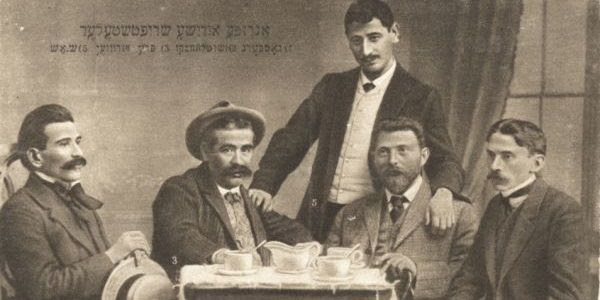
Final Call for Papers: Modern Jewish History and the Power of Language
There are only a few weeks remaining to submit your proposals for our upcoming international academic conference at the POLIN Museum. As part of the programming accompanying our temporary exhibition, “The Power of Words: On Jewish Languages,” we invite researchers to join us in Warsaw this June to explore the linguistic evolution of the Jewish diaspora.
The conference investigates the profound influence of language on Jewish life from the 18th to the late 20th century. We aim to interrogate how linguistic choices shaped modern Jewish identity, political movements, and social transformations globally. We will be looking at topics such as the role of Yiddish, Hebrew, and Esperanto in the formation of Zionist and diasporic political movements, as well as the decline of traditional languages like Ladino and Judeo-Arabic and the rise of modern Jewish English and Jewish Swedish.
Organizational Details:
- Date & Venue: 1–3 June 2026, POLIN Museum of the History of Polish Jews, Warsaw.
- Deadline for Applications: 15 February 2026.
- Language: The conference will be conducted entirely in English.
- Support: The organizers provide meals and accommodation for participants. Partial travel reimbursement is available, with priority given to early-career and independent researchers.
We welcome submissions from scholars across history, sociology, linguistics, and related disciplines. Please note that the proceedings will be recorded for future publication.
KEYNOTE ADDRESS
KeyNow Available: Digital Cloaks and Algorithmic Shadows
We are pleased to announce that the recording of our recent conference keynote address, “Digital Cloaks and Algorithmic Shadows: Online Holocaust Denial in the Age of AI,” is now available for public viewing.
In this compelling session, Dr. Lev Topor (Academic College of Tel Aviv-Yaffo) explores the dangerous evolution of Holocaust distortion. From the “cloaks” of digital anonymity in encrypted channels to the “shadows” cast by generative AI, Dr. Topor traces how denialist narratives have moved from fringe forums to the forefront of technological disruption. Dr. Topor draws on his extensive background in both antisemitism and cybersecurity to argue that we must safeguard the integrity of our digital landscape to protect the memory of the past.
RECORDINGS AVAILABLE
Conference Recordings Now Available: Confronting Holocaust Distortion in the Digital Era
The video recordings from the international conference “Confronting Holocaust Distortion in the Digital Era,” held at the POLIN Museum from November 18–20, 2025, are now available for viewing.
This landmark event brought together a global community of scholars, educators, and museum professionals to diagnose and develop strategies against the rising tide of digital Holocaust distortion. The sessions offer deep insights into:
- Polish Perspectives: A dedicated look at the evolution of Holocaust discourse and scientific approaches in Poland.
- The AI Challenge: Expert panels on the ethical hurdles and manipulative potential of artificial intelligence and generative tools.
- Algorithmic Distortion: An analysis of how social media algorithms and bot networks amplify false narratives.
- Educational Strategies: Practical roundtables on countering denial in the classroom and public museum spaces.
How to Access the Recordings
To ensure the integrity of the discussion and manage access to these sensitive materials, the recordings are available upon request.
To receive the access links, please send an email to: digital@polin.pl