


Prof. Matt Coler’s lecture entitled “Speech technology as interdisciplinary science” | December 16th, 2025
15 12 2025
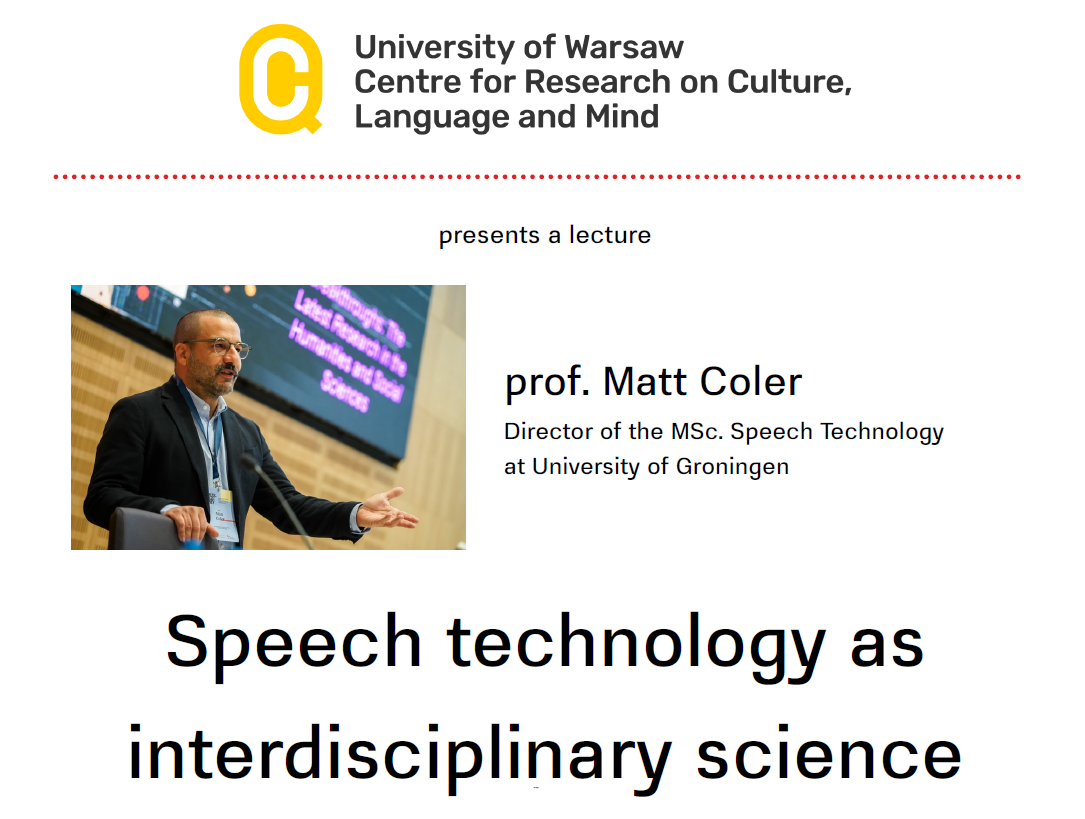
On 16 December 2025 at 11:30, we will host Prof. Matt Coler, Director of the MSc. Speech Technology programme at the University of Groningen, who will deliver a lecture entitled “Speech technology as interdisciplinary science.”
Venue: Old Library Building (Stary BUW), room 107, 11:30
The lecture is organised by the Centre for Research on Culture, Language and Mind at the University of Warsaw.
We warmly encourage everyone interested in language, technology, speech research, and their intersecting paths to join us.
More information can be found on the Centre’s website: centrumq.uw.edu.pl
Matt Coler is Associate Professor of Speech Technology at the University of Groningen, where he directs the MSc Speech Technology program and is head of the Governance and Technology department. He serves as Ethics Chair for Interspeech 2025, and recently served as Vice Chair of the LITHME COST Action, an EU-funded research network examining language technology in society. The research of his Speech Tech Lab brings together linguistic theory, AI ethics, and speech technology to expand access to language technologies for underrepresented communities.
Artificial intelligence has revolutionized speech synthesis, yet this breakthrough excludes all but a handful of major languages. Through an interactive audio history spanning from Von Kempelen’s 1791 mechanical apparatus to today’s neural architectures, this talk traces how each era reimagined what speech fundamentally is: from physical resonance to encodable information to learnable patterns. Live demonstrations show how small regional languages can achieve natural synthesis, challenging assumptions about data requirements. But technical solutions raise more in-depth questions: What transforms when voice moves from embodied cultural practice to decontextualized acoustic reproduction? When lived stimulation becomes technological stimulus? These questions reveal why speech technology increasingly requires methodological contributions from social sciences and humanities: not as auxiliary concerns, but as perspectives on what breakthrough actually means in a field dominated by engineering.